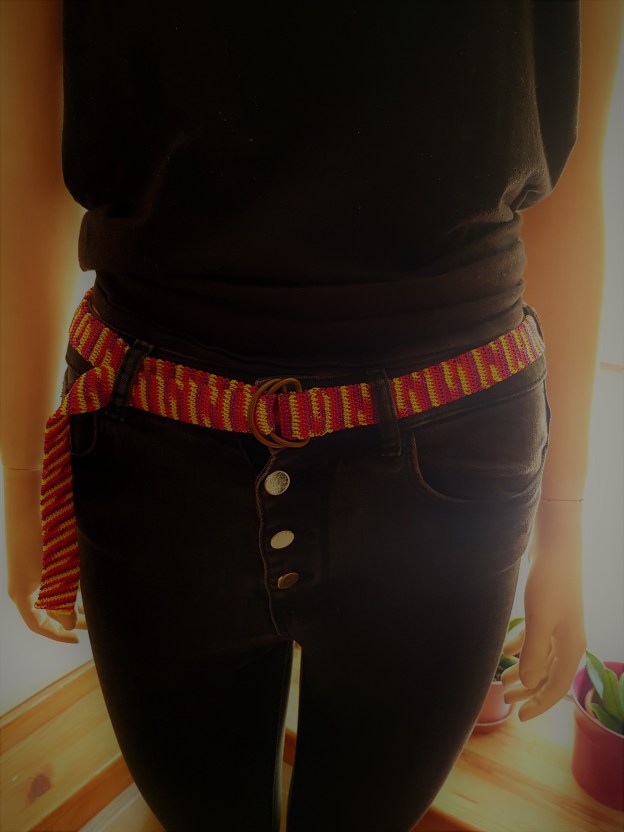
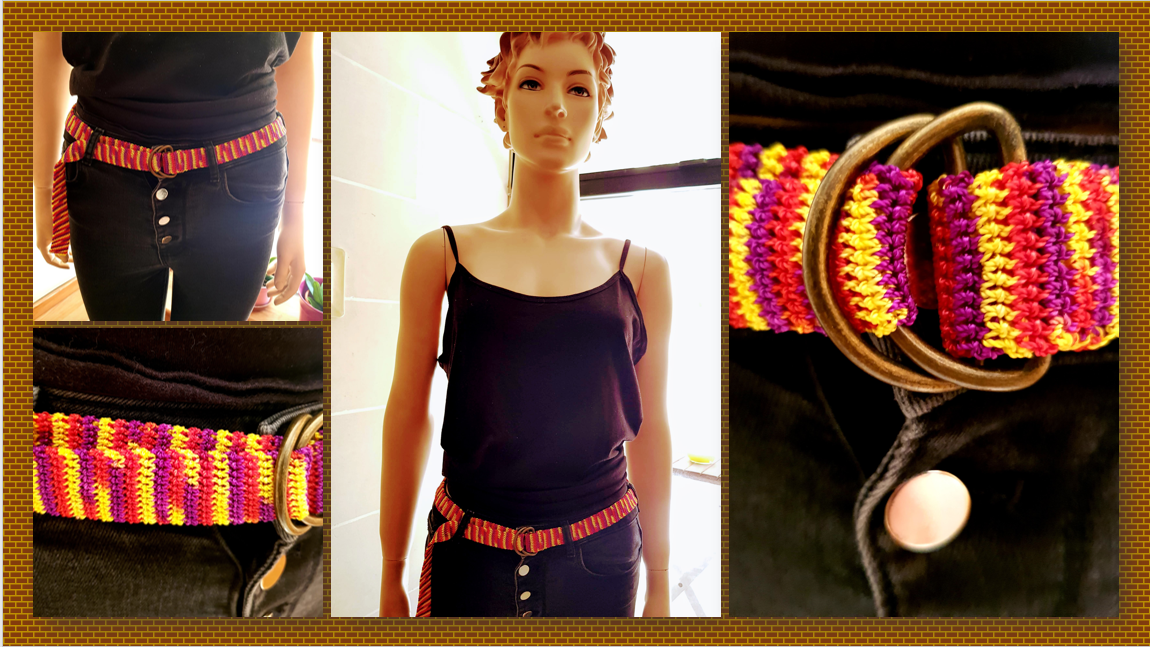
I recently bought some rather nice nylon crochet thread because I really liked the colours. Nylon is quite stiff and abrasive , so you have to be careful what you use it for. I decided to make a belt. The pattern is quite straight forward – it’s mainly single crochet (US Terms). However, even though the nylon is stiff, I did a double layer as I felt that the belts should be pretty stiff. Here is the pattern :
I used a 1.4mm crochet hook for this project.
CH – chain stitch SC – single crochet
YO – yarn over
Start with 11 CH
Row 1: skip first chain and 1 SC into remaining 10 CH, ch 1 and turn
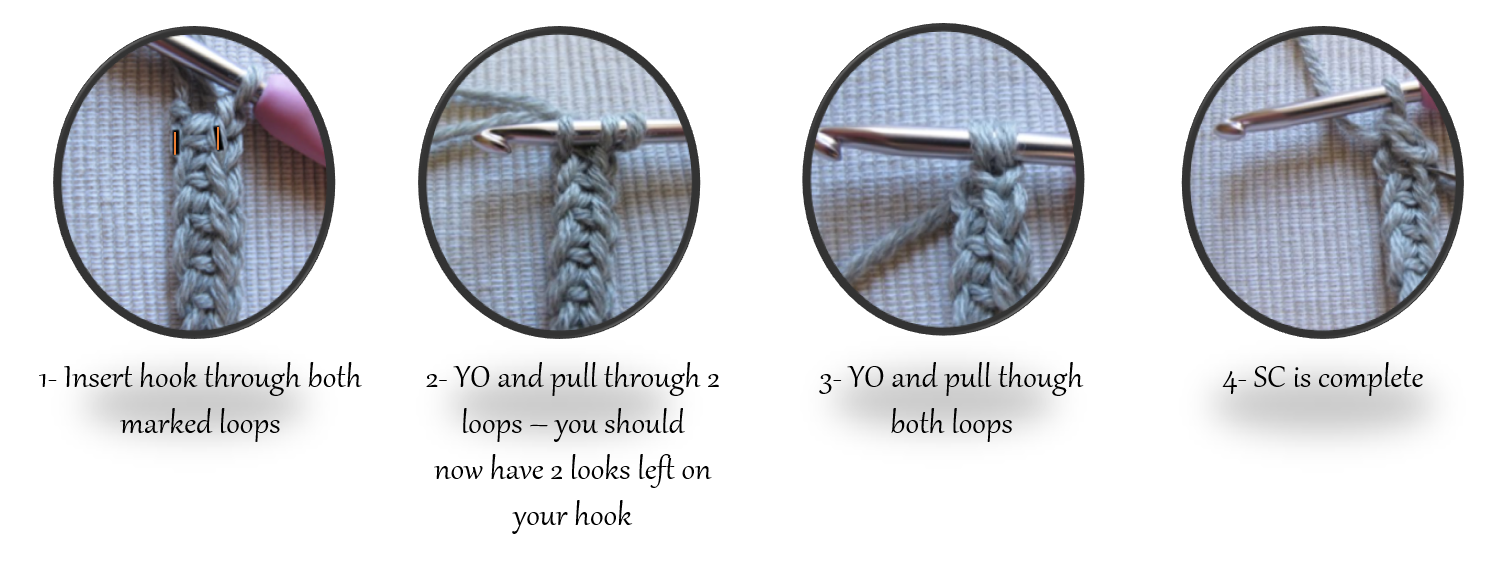
Row 2: To create a double layer SC, put hook through the backloop only of the SC made on row 1 and also the loop left over from initial chain stitch (see marked image below). Repeat till end of row, ch1 and turn.
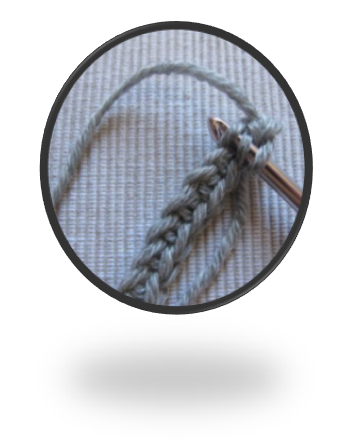
Row 3 : From now on, the double layer sc will be easier to make. Insert hook through the leftmost loop in the sc just made on last row, and in the remaining loop in the corresponding stitch in the previous row. Repeat till end of the row, ch1 and turn.
Keep working this way till you reach the desired length.
For the buckle, I used 2 brass hoops, recycled from an old handbag .
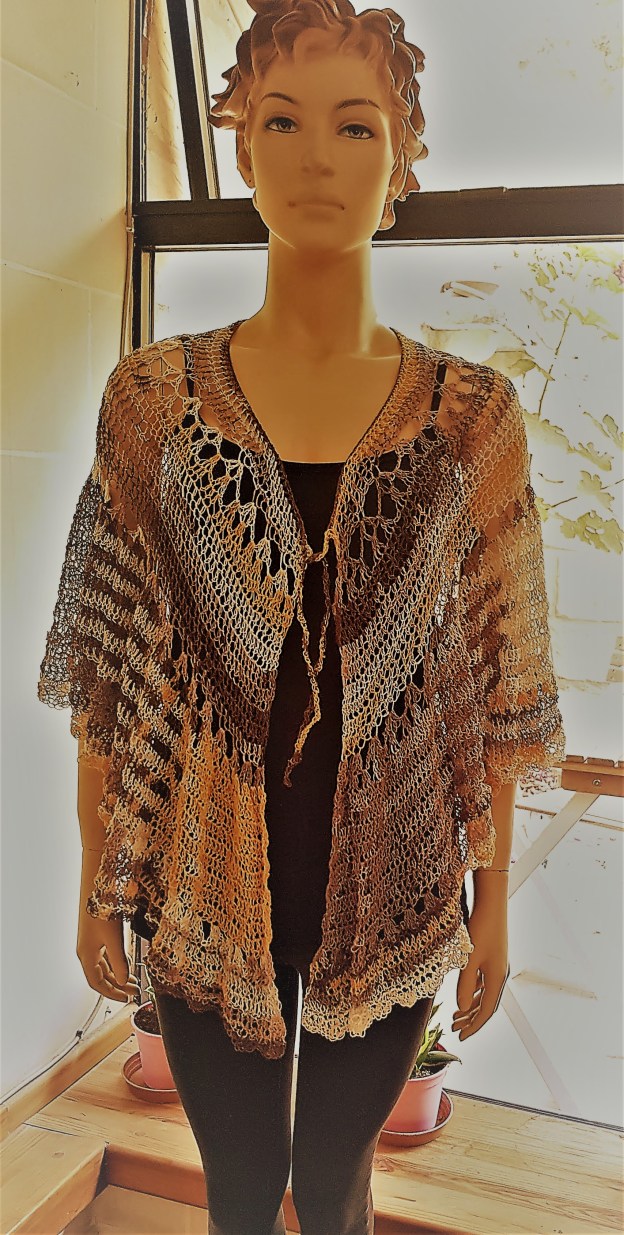
I came across this really beautiful boho-inspired wrap – and here is my version. I used different yarn and hook size – which explains the difference in size from the one you see in the pattern – but I love it!
Hey everyone! Hope you are all enjoying summer and safe ! I might have mentioned once or twice, or a hundred times that I love winter – I am totally a winter person. I love being able to snuggle with soft, warm woolly things – so it is no surprise that I make a lot of winter projects.
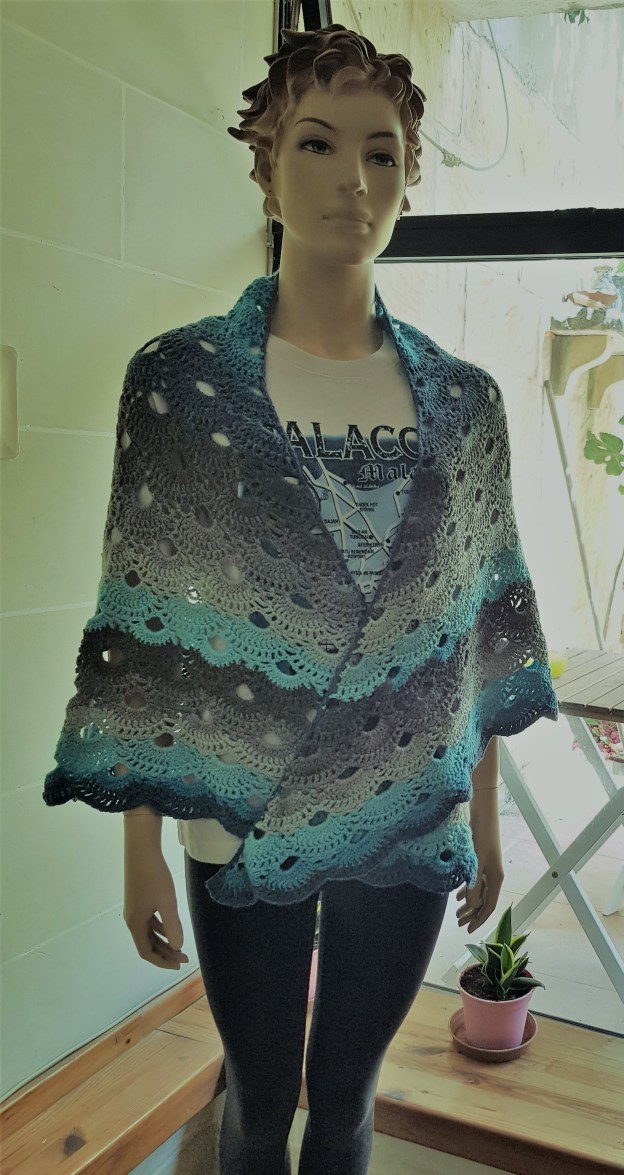
Firstly, a little disclaimer about the title of this post and the name of this pattern i.e. “The Virus Shawl” – this name and pattern has been around for years and has nothing to do with COVID-19.
I have made a few shawls so far, but it’s always been a challenge to properly show-case these without a model. I have asked politely, then begged and even tried to bribe my lovely daughter into being my model – but with no luck . So, I now am a proud owner of a mannequin!
Here is one of the shawls that I made . There are several free patterns available online. However, here is one you could refer to – it includes a written pattern in form of graph as well as YouTube videos for both right and left-handed crocheters. If you do try making this, I would love to see your creations! Please feel free to share in comments to this post : https://www.woolpedia.de/english/crochet-tutorials/shawl/
N.B. I used a variegated 4-ply yarn, and used a 4-mm hook.
A few posts ago, I shared a free pattern for a beach dress (size 8-10) published by Katia at (https://www.katia.com/EN/patterns-spring-summer-woman-dress-8031-488.html.).The pattern is available only in graph form – which is quite hard to follow, so I have prepared a written version. I did try to modify this so that rather than preparing front and back pieces and then sewing them, just making one continuous piece. This was not as easy as just doubling up on the stitches – there was much frogging involved I don’t know how many times I had to undo and redo this to maintain symmetry. Therefore, it is far simpler to follow the 2 piece pattern, so that is what I have written up here. The other modification I did was this time, I crocheted fixed straps to the pattern . Enjoy!
Crochet hook size used: 3mm and 4mm
Yarn : Katia Jaipur cake
Stitches:
CH – chain stitch SC – single crochet DC – double crochet DC3tog – DC 3 together
We will be making the front and back of the dress (which are identical) separately and then stitch them together at the end.
In addition, the pattern calls for making 4 straps and then stitching them to the back and front pieces.
STRAPS (make 4) Using the 4mm crochet hook and 3 strands of yarn, work a strip of chain stitch measuring 40cm long. Cut the yarn and fasten off.
BACK Using 3mm crochet hook, CH 83.
Row 1: CH 3, DC3tog (1st DC is CH 3, 2nd DC is made in CH 5 from hook) , 38 DC, 5 DC in next CH, 38 DC, DC3tog
Row 2 – 4: DC3tog (1st DC is CH 3) , 38 DC, 5 DC in next DC, 38 DC, DC3tog
Row 5: CH, [(SC, CH, skip DC) x 20], (SC, CH, SC) in next DC, [(CH, skip DC, SC) X 20], SC.
Row 6 : CH, SC, [(SC, CH, skip DC) x 20], (SC, CH, SC) in next CH, [(CH, skip DC, SC) X 21].
Row 7: CH 3, 42 DC, 5 DC in next CH, 43 DC
Row 8: CH 3, 44 DC, 5 DC in next DC, 45 DC
Row 9: CH 3, 46 DC, 5 DC in next DC, 47 DC
Row 10: CH 3, 48 DC, 5 DC in next DC, 49 DC
Row 11: CH, [(SC, CH, skip DC) x 25], (SC, CH, SC) in next DC, [(CH, skip DC, SC) X 25], SC.
Row 12 : CH, SC, [(SC, CH, skip DC) x 25], (SC, CH, SC) in next CH, [(CH, skip DC, SC) X 26].
Row 13: CH 3, 52 DC, 5 DC in next CH, 53 DC
Row 14: CH 3, 54 DC, 5 DC in next DC, 55 DC
Row 15: CH 3, 56 DC, 5 DC in next DC, 57 DC
Row 16: CH 3, 58 DC, 5 DC in next DC, 59 DC
Row 17: CH, [(SC, CH, skip DC) x 30], (SC, CH, SC) in next DC, [(CH, skip DC, SC) X 30], SC.
Row 18 : CH, SC, [(SC, CH, skip DC) x 30], (SC, CH, SC) in next CH, [(CH, skip DC, SC) X 31].
Row 19: DC3tog (1st DC is CH 3) , 61 DC, 5 DC in next CH, 60 DC, DC3tog
Row 20: DC3tog (1st DC is CH 3) , 60 DC, 5 DC in next DC, 61 DC, DC3tog
Row 21: DC3tog (1st DC is CH 3) , 61 DC, 5 DC in next DC, 60 DC, DC3tog
Row 22: DC3tog (1st DC is CH 3) , 60 DC, 5 DC in next DC, 61 DC, DC3tog
Row 23 : CH, SC, [(SC, CH, skip DC) x 31], (SC, CH, SC) in next DC, [(CH, skip DC, SC) X 31], SC.
Row 24 : CH, SC, [(SC, CH, skip DC) x 31], (SC, CH, SC) in next SC, [(CH, skip DC, SC) X 31], SC.
Row 25: DC3tog (1st DC is CH 3) , 63 DC, 5 DC in next CH, 62 DC, DC3tog
Row 26: DC3tog (1st DC is CH 3) , 62 DC, 5 DC in next DC, 63 DC, DC3tog
Row 27: DC3tog (1st DC is CH 3) , 63 DC, 5 DC in next DC, 62 DC, DC3tog
Row 28: DC3tog (1st DC is CH 3) , 62 DC, 5 DC in next DC, 63 DC, DC3tog
Row 29 : CH, SC, [(SC, CH, skip DC) x 32], (SC, CH, SC) in next DC, [(CH, skip DC, SC) X 32], SC.
Row 30 : CH, SC, [(SC, CH, skip DC) x 32], (SC, CH, SC) in next CH, [(CH, skip DC, SC) X 32], SC.
Row 31: DC3tog (1st DC is CH 3) , 65 DC, 5 DC in next CH, 64 DC, DC3tog
Row 32: DC3tog (1st DC is CH 3) , 64 DC, 5 DC in next DC, 65 DC, DC3tog
Row 33: DC3tog (1st DC is CH 3) , 65 DC, 5 DC in next DC, 64 DC, DC3tog
Row 34: DC3tog (1st DC is CH 3) , 64 DC, 5 DC in next DC, 65 DC, DC3tog
Row 35 : CH, [(SC, CH, skip DC) x 33], (SC, CH, SC) in next DC, [(CH, skip DC, SC) X 33], SC.
Row 36 : CH, SC, [(SC, CH, skip DC) x 33], (SC, CH, SC) in next CH, [(CH, skip DC, SC) X 34].
Row 37: CH 3, 68 DC, 5 DC in next CH, 69 DC
Row 38: DC3tog (1st DC is CH 3) , 68 DC, 5 DC in next DC, 68 DC, DC3tog
Row 39: CH 3, 70 DC, 5 DC in next DC, 71 DC
Row 40: DC3tog (1st DC is CH 3) , 70 DC, 5 DC in next DC, 70 DC, DC3tog
Row 41 : CH, [(SC, CH, skip DC) x 36], (SC, CH, SC) in next DC, [(CH, skip DC, SC) X 36], SC.
Row 42 : CH, SC, [(SC, CH, skip DC) x 36], (SC, CH, SC) in next CH, [(CH, skip DC, SC) X 36].
Row 43: CH 3, 74 DC, 5 DC in next CH, 75 DC
Row 44: DC3tog (1st DC is CH 3) , 74 DC, 5 DC in next DC, 74 DC, DC3tog
Row 45: CH 3, 76 DC, 5 DC in next DC, 77 DC
Row 46: DC3tog (1st DC is CH 3) , 76 DC, 5 DC in next DC, 76 DC, DC3tog
Row 47 : CH, [(SC, CH, skip DC) x 39], (SC, CH, SC) in next DC, [(CH, skip DC, SC) X 39], SC.
Row 48 : CH, SC, [(SC, CH, skip DC) x 39], (SC, CH, SC) in next CH, [(CH, skip DC, SC) X 40].
Row 49 – 52: DC3tog (1st DC is CH 3) , 78 DC, 5 DC in next DC, 78 DC, DC3tog
Row 53 : CH, [(SC, CH, skip DC) x 40], (SC, CH, SC) in next DC, [(CH, skip DC, SC) X 40], SC.
Row 54 : CH, SC, [(SC, CH, skip DC) x 40], (SC, CH, SC) in next CH, [(CH, skip DC, SC) X 41].
Row 55: DC3tog (1st DC is CH 3) , 80 DC, 5 DC in next CH, 80 DC, DC3tog
Row 56 – 58: DC3tog (1st DC is CH 3) , 80 DC, 5 DC in next DC, 80 DC, DC3tog
Row 59 : CH, [(SC, CH, skip DC) x 41], (SC, CH, SC) in next DC, [(CH, skip DC, SC) X 41], SC.
Row 60 : CH, SC, [(SC, CH, skip DC) x 41], (SC, CH, SC) in next CH, [(CH, skip DC, SC) X 42].
Row 61: DC3tog (1st DC is CH 3) , 82 DC, 5 DC in next CH, 82 DC, DC3tog
Row 62 – 64: DC3tog (1st DC is CH 3) , 82 DC, 5 DC in next DC, 82 DC, DC3tog
Row 65 : CH, [(SC, CH, skip DC) x 42], (SC, CH, SC) in next DC, [(CH, skip DC, SC) X 42], SC.
Row 66 : CH, SC, [(SC, CH, skip DC) x 42], (SC, CH, SC) in next CH, [(CH, skip DC, SC) X 43].
Row 67: DC3tog (1st DC is CH 3) , 84 DC, 5 DC in next CH, 84 DC, DC3tog
Row 68 – 70: DC3tog (1st DC is CH 3) , 84 DC, 5 DC in next DC, 84 DC, DC3tog
FRONT Work the same as Back
FINISHING Sew on straps: Attach one strap to each end of the starting row of Front and Back pieces . Sew the sides: align the back and front pieces and sew from end (row 70) up until row 16 .
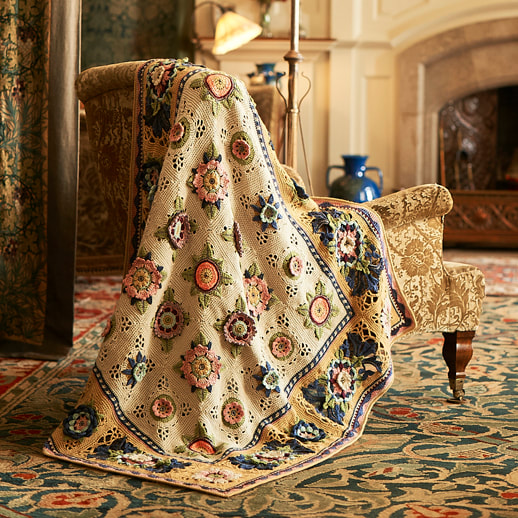
I recently came across a post in one of the Facebook crochet groups for a most beautiful Crochet-Along (CAL) project inspired by embroidery works by May Morris, daughter of William Morris . I could not resist – so I signed up, bought the yarn pack and have just started.
As we have just started, only the first part of the pattern has been released, and I can say that it is written very clearly. The designer has also provided a youtube video, in which she has shared some really good tips. I will surely be applying some of the tips to all my projects henceforth – so very worth taking a look.
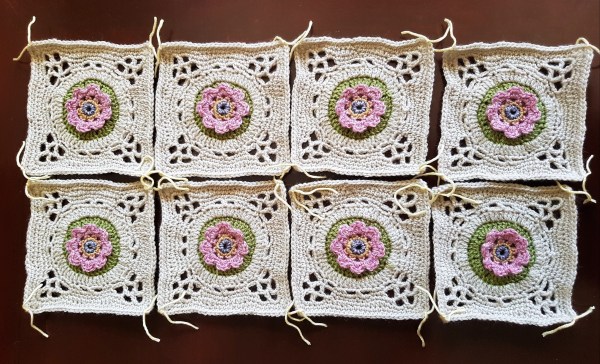
Here is my first set of tiles. (Note that these are not blocked yet as we will be blocking them at the end of the project. Also, the threads you see in the corners are actually being used as stitch markers.)
I find the most efficient approach to making multiple tiles in the same pattern is to first do one completely, so you familiarise yourself with the pattern, and then work on the remaining colour by colour. So, in this set, I did one tile completely, and for the remaining 7 tiles, – I first crocheted 7 flowers, then did the green background for all 7, then proceeded to do the parchment part. There is no rule of how you should do this, it’s just a matter of preference.
This pattern is available in 2 colour recipes (a third is expected in September 2020, when this CAL will be run again). Nonetheless, you could also come up with your own colour combination. I have also seen a monochrome version of the tile which someone tried out – and it is quite pretty – but I love colours – so it’s not for me 🙂 .
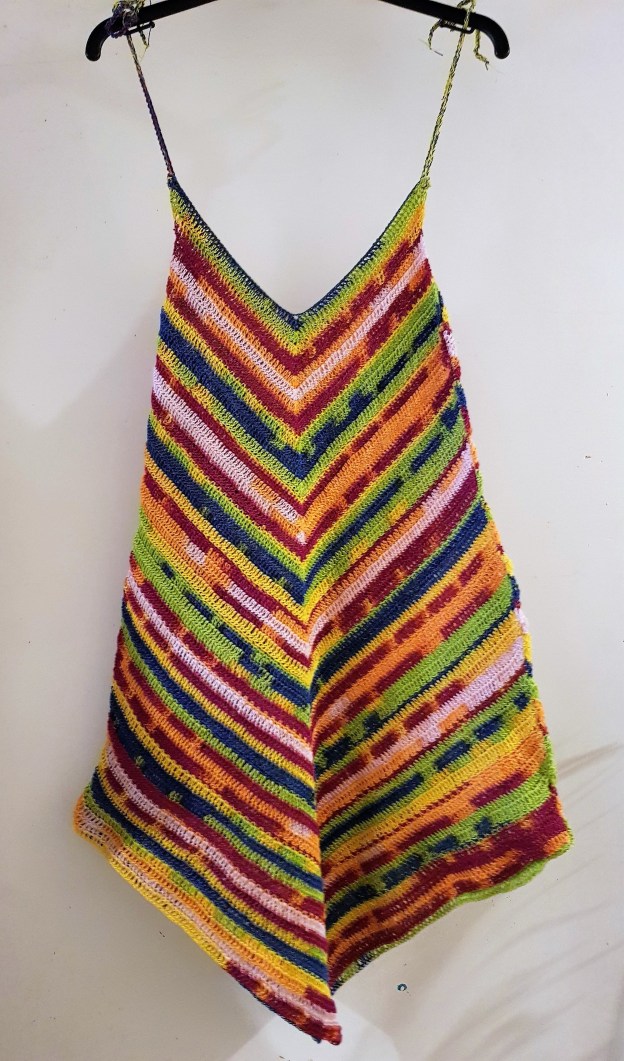
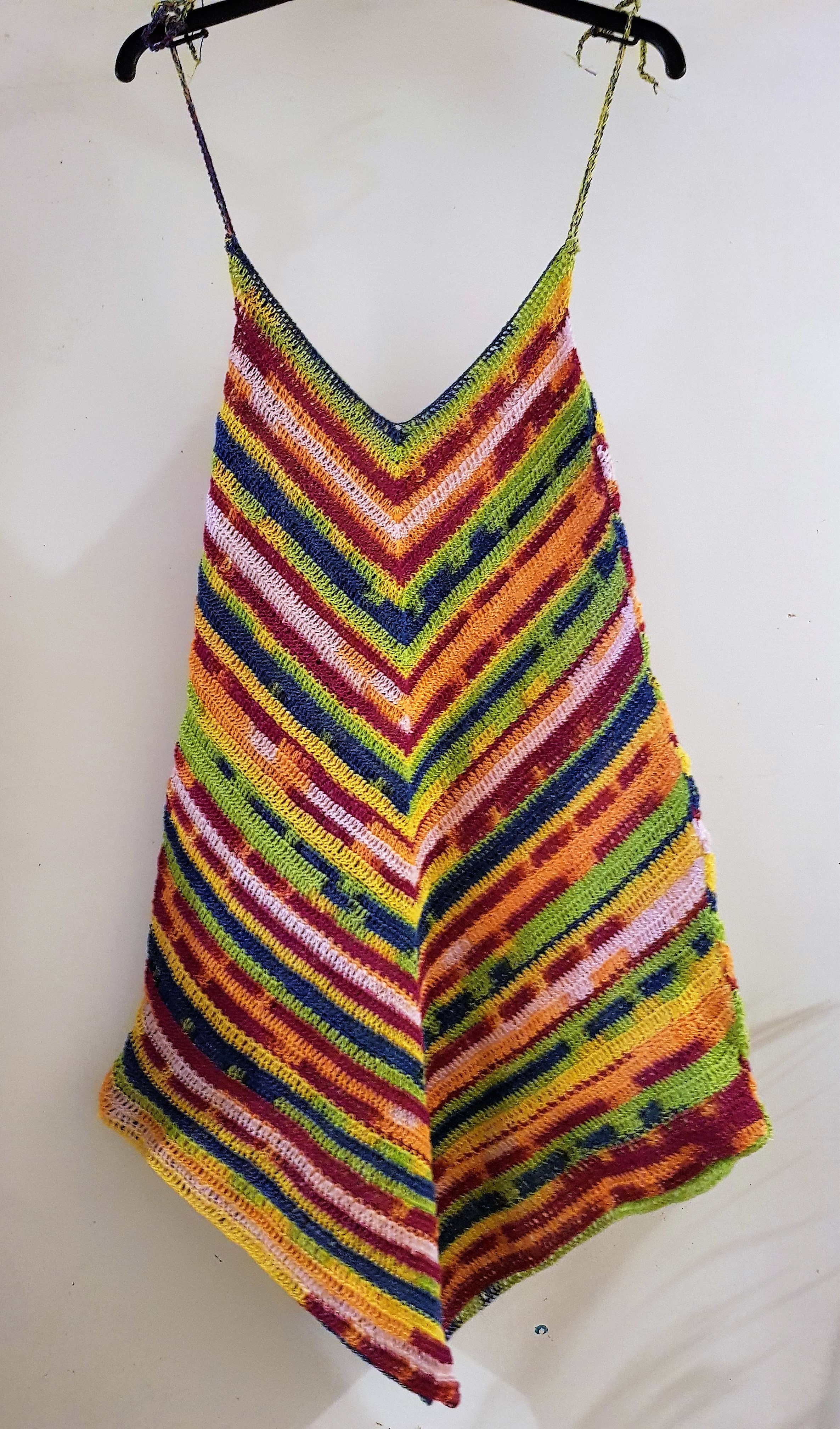
Summer is round the corner – so here is my first creation for summer – a stylish multi-coloured beach dress. It’s made using the Jaipu Cake cotton yarn from Katia.
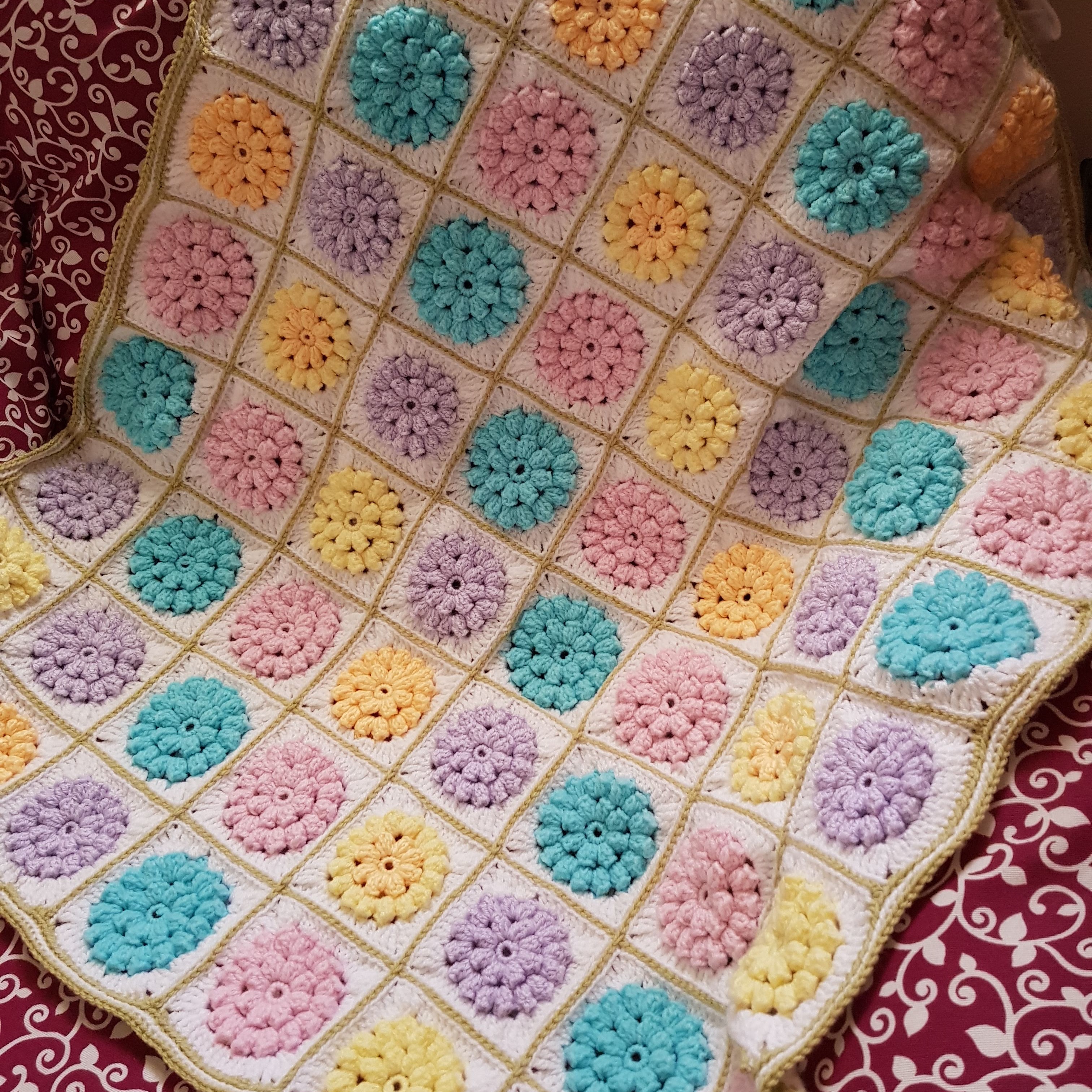
I’m so happy with this gorgeous baby blanket which I made for a friend . It’s using the same technique as in my last post (Colourful Lapghan). Next up will be a cute little girls handbag…..keep a lookout for it!
I’ve been rather busy putting this very colourful lapghan together . It’s similar to the Colourful Lined Baby blanket I made some time back . Hope you like it! I’m now working on one in pastel colours. Check back soon for updates!
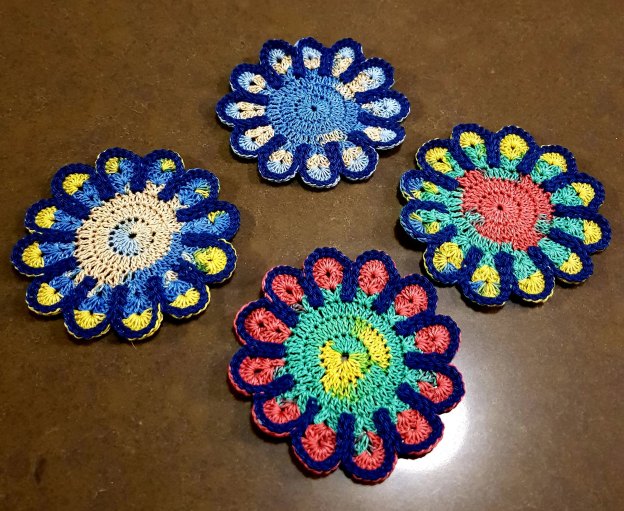
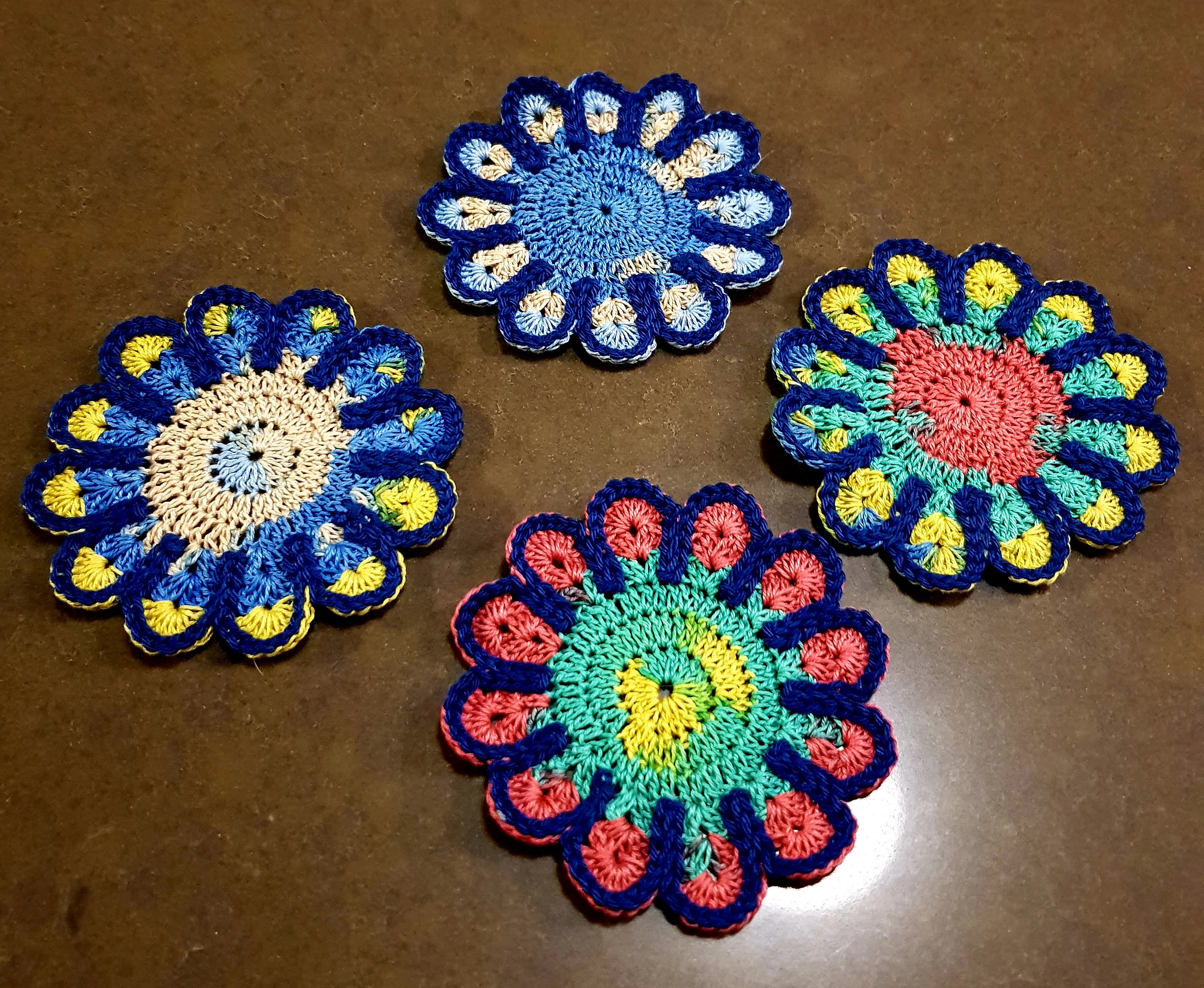
I came across this cute coaster pattern sometime back (actually it’s been a few years!), and I knew I would make them, but not immediately. I guess I was waiting to have the right yarn in hand. I used a variegated cotton yarn for the flower and then a thicker dark blue cotton yarn for the petal outline. What do you think?
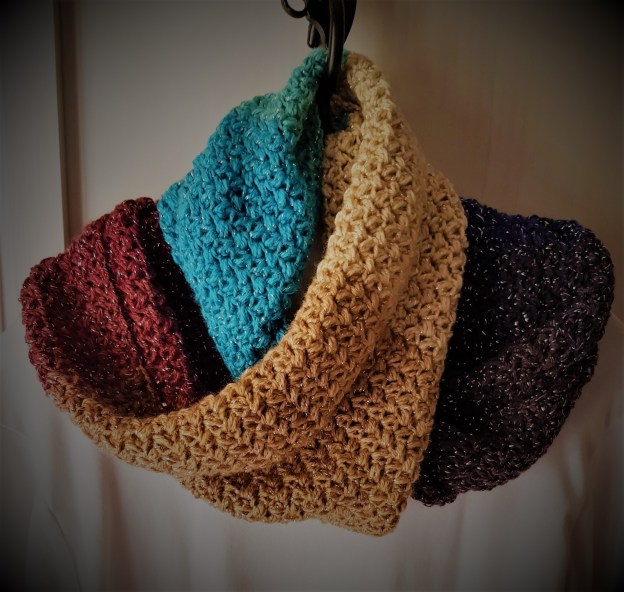
I love winter, and it is slowly on it’s way in 🙂 One of the things I love about winter is the clothes – those warm, soft & fluffy woolies, in which you wrap up tight. So, here is my first project in preparation for this season : the infinity scarf.
I love infinity scarves as they are so versatile and you can wear them in many ways.
For this one, I have used a variagated yarn by Katia which has a gold thread running through it, but you can use any yarn of your choice. As for stitch choice, I used the puff stitch because it forms double-sided bobbles that are both thick and fluffy – just what you want for your scarf.
This is a really easy project, and in case you have not made a puff stitch before, here is an explanation :
Step 1 : – Start by making a chain ( it should be in multiples of 2 stitches plus 4) till it is as wide as you would like your scarf to be.
Step 2: – Once you have made the chain, yarn over hook and insert the hook into the 4th chain from hook. Yarn over again and draw up a loop. You should have three loops on your hook. ** Yarn over hook and insert the hook into the same 4th chain from hook. Yarn over again and draw up a loop. ** Repeat from. You should now have 7 loops on the hook. (N.B. some people will even make puff stitches with 9 or 11 loops – it’s totally upto you – but I opted for 7.)
Step 3 : – Yarn over and draw the yarn through all the loops. This is your Puff Stitch.
Step 4: – With the loop pulled through the puff stitch, make a single chain to secure your Puff stitch.
Step 5: – Skip 1 chain stitch and make your next puff stitch in the next chain stitch. Repeat till you get to the end of the chain. You should end the row with a puff stitch.
Step 6: – At the end of your row, flip your work and make 3 chain stitches.
Step 7:- For all subsequent rows, make your puff stitches in the chain-1 space from the previous row.
Repeat till the scarf is as long as you like. Once done, I joined the last row to the initial row with slip stiches – but you can sew this if you prefer.














 Manjri's Place